

In the Caribbean, hurricanes are not distant threats on a forecast map. They are lived realities that can reshape entire nations in a matter of hours. In the Caribbean, hurricanes are not distant threats confined to weather forecasts—they are recurring realities capable of reshaping entire nations in a matter of hours. Every hurricane season brings with it the possibility that the next storm could be the one that changes everything.
For Grenada, that question became painfully real in 2004.
Before that year, many people in Grenada held a quiet but dangerous belief that hurricanes would simply pass them by. This mindset was reinforced by the fact that the last major hurricane, Hurricane Janet in 1955, had occurred almost 50 years earlier, meaning that for many people the fear of such storms had either faded with time or was never personally experienced. It was a false sense of security—an assumption rooted more in hope than in science or lived experience. Storm warnings were heard, but often shrugged off. Emergency kits were rarely prepared. Roofs were left unreinforced. Water, food, and essential supplies were not routinely stored. For many households, the response was simple: carry on as normal and deal with the storm only if it became unavoidable.
That mindset changed when Hurricane Ivan struck in September 2004.
The storm did not just damage Grenada—it overwhelmed it. Around 90 percent of infrastructure was damaged or destroyed. Homes were stripped, schools collapsed, hospitals were crippled, and public utilities failed almost simultaneously. Infrastructure and property were reduced to fragments in a matter of hours.
Most devastating of all, 39 lives were lost.
Beyond the human toll, the economic impact was staggering. Estimated losses reached approximately 1 billion US dollars, about twice the country’s Gross Domestic Product at the time. For a small island economy, this was not just destruction; it was a national setback that affected development, employment, education, and public services for years.
The experience of Grenada is not an isolated story. Across the Caribbean and beyond, geographic exposure, limited land space, and concentrated infrastructure mean that a single hurricane can simultaneously disrupt transport systems, contaminate water supplies, displace thousands, and overwhelm emergency response capacity.
Preparedness, therefore, cannot be treated as seasonal advice. It must be a permanent national priority.
This begins at the household level. Preparedness means more than awareness—it means action taken before warnings intensify. Emergency kits must be ready before storms form, not after alerts are issued. Roofs must be secured, trees properly managed, important documents protected, and evacuation routes understood in advance. Most importantly, it requires a shift in mindset: from “it will not happen to me” to “I must be ready because it can happen to anyone.”
At the national and community levels, resilience depends on sustained investment in stronger building codes, climate-resilient infrastructure, reliable early warning systems, and continuous public education. Preparedness cannot be a campaign that appears only when a storm approaches. It must be embedded into daily governance and planning.
Equally important is the recognition that recovery always costs more than prevention, both financially and emotionally.
The years following Ivan reinforced this reality. When Hurricane Emily passed in 2005, recovery efforts were still underway. The storm highlighted how quickly one disaster can follow another, leaving little time for full rebuilding and exposing the fragility of systems still in repair. In response to the scale of national risk, the government invested in a national-level insurance mechanism with the Caribbean Catastrophe Risk Insurance Facility (CCRIF) to strengthen
financial resilience and ensure that recovery funding would be available more quickly after future disasters.
Nearly two decades later, when Hurricane Beryl affected Grenada and the region in 2024, there were clear signs of progress. Public awareness had improved. Early warning systems were more effective. Communities responded with greater urgency and coordination than in the past. Yet gaps remained, reminders that resilience is still a work in progress, not a finished achievement.
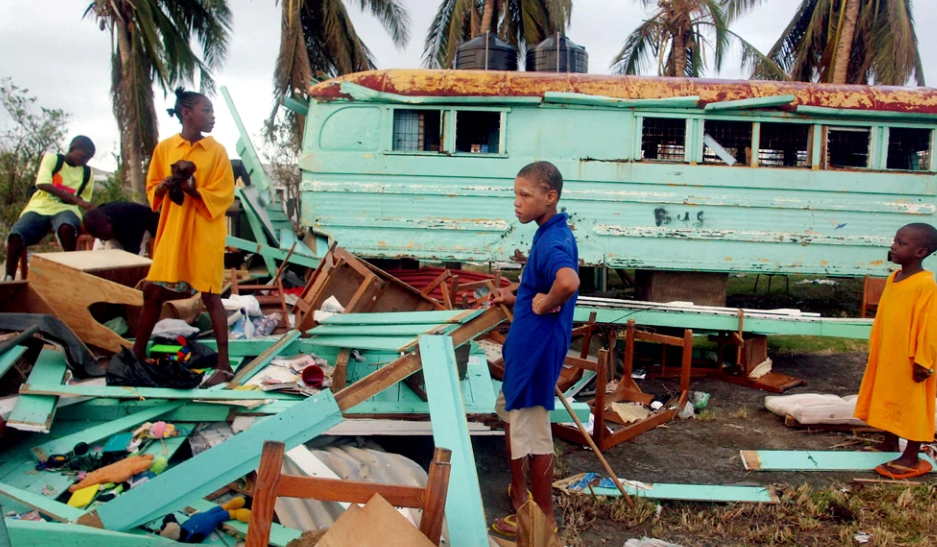
Photo: NBC News
Hurricane Ivan in Grenada 2004
Each storm has added another layer to the same lesson: preparedness saves lives, protects
economies, and shortens recovery.
Today, that lesson carries even greater weight. Climate change is intensifying storm systems, increasing uncertainty, and stretching the limits of already vulnerable states. The margin for error is shrinking.
In this context, preparedness is no longer just good policy. It is survival strategy.
The real question facing the Caribbean is no longer whether another major hurricane will come. Rather than hoping it will pass us by, we must prepare as though it could make landfall. That message has become even more urgent in recent years, as warmer ocean temperatures and changing climate patterns have contributed to stronger, more rapidly intensifying storms. The question is no longer whether we should prepare, but whether we will be ready when the next
hurricane comes. The decisions made today will ensure that when it does, communities will withstand it, recover faster, and lose fewer lives in the process.